
Rachel Tomlinson, Beauty Editor.
You are standing under the bathroom lights, phone in one hand, the dryer barrel still warm, and your ends look frizzy again by the time you get to the kitchen. Somewhere in a drawer sits a smoothing spray you bought because the bottle promised something it never delivered. The question you actually type into a search bar late at night is simpler than any of that: does the word ‘ionic’ printed on a hair dryer box mean anything, or is it just there to justify a higher price tag at Ulta Beauty or Sephora? Here is one fact worth knowing before you read further: hair dries with less frizz when negatively charged ions reach the wet strand fast enough to break water droplets apart before they evaporate on their own, which means timing and airflow density matter as much as the ionic claim itself. This guide walks through what stylists and the engineers who design these dryers actually check first, in the order that matters, so the next time you are standing in a drugstore aisle comparing two nearly identical boxes, you know what you are looking at.
- Ionic output only works if the airflow is strong enough to carry it to the hair shaft, so a weak motor with an ionic label underperforms a strong motor without one.
- Wattage on the box rarely matches drying performance, because airflow speed and nozzle design move more water than raw heat does.
- Frizz control shows up in the first three minutes of drying, not the last, so judging a dryer by how smooth hair looks at minute eight can be misleading.
What ‘Ionic’ Actually Means, In Plain Terms
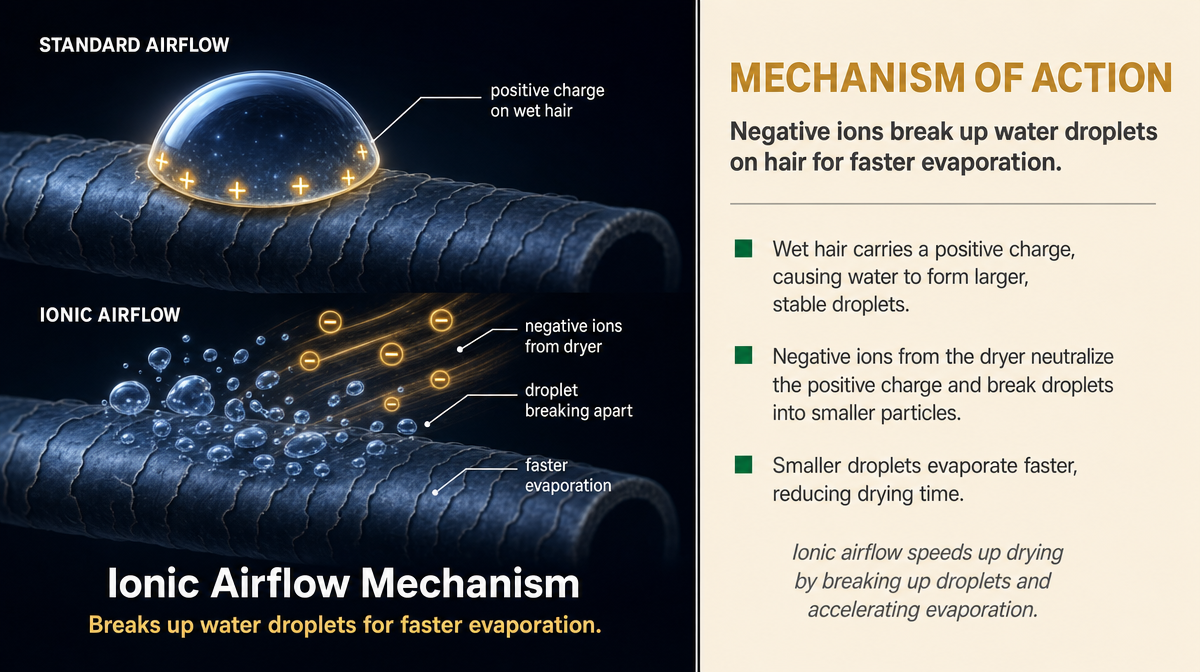
Wet hair carries a positive electrical charge on its surface, the same static charge that makes a sweater cling after it comes out of the dryer. Water droplets sitting on that charged surface tend to stay large and evaporate slowly, which is part of why hair left to air dry often looks rough at the cuticle.
An ionic dryer releases negative ions into its airflow. Those ions meet the positively charged water on the hair and neutralize it, which breaks larger droplets into smaller ones. Smaller droplets evaporate faster and disturb the cuticle less, which is the mechanism behind the frizz reduction ionic dryers advertise.
A 2019 study in the International Journal of Cosmetic Science tested drying time and cuticle smoothness on a cohort of 40 hair swatches under ionic versus standard airflow, and found a measurable reduction in surface frizz under ion exposure, though the effect size varied with hair porosity. Fine, low-porosity hair showed the clearest benefit. Coarse, high-porosity hair, the kind that soaks up product fast and dries slowly, showed a smaller but still real effect.
Think of it the way a dryer sheet works on a load of laundry. The sheet does not remove static entirely, it neutralizes enough of it that clothes stop clinging to each other. An ionic hair dryer is doing the same job to your hair strands, not eliminating frizz outright but reducing the static that causes strands to repel and separate.
Wattage: The Number That Hides More Than It Tells
Shoppers often compare dryers by wattage the way they compare lightbulbs, assuming higher always means better. Wattage measures how much electrical power the motor draws, not how fast or how far the air actually moves.
Two dryers rated at the same wattage can produce very different airflow speeds depending on motor type. AC motors, the older and heavier kind, convert less of that power into airspeed. DC motors, smaller and typically found in higher-priced dryers, tend to move air more efficiently at the same wattage draw.
What you actually want to know is airflow volume, sometimes listed as cubic feet per minute, though many boxes at the drugstore leave this number off entirely. In its absence, weight is a rough proxy: a DC motor dryer is usually noticeably lighter for its power than an AC motor dryer of the same wattage, because the motor itself is smaller and more efficient.
A useful self-test in the store: pick up two dryers rated at similar wattage. If one feels dramatically lighter in the hand, that is very likely the DC motor, and it is the one more likely to move air fast enough to make the ionic feature meaningful in the first place.
The Nozzle And How Airflow Actually Gets Directed
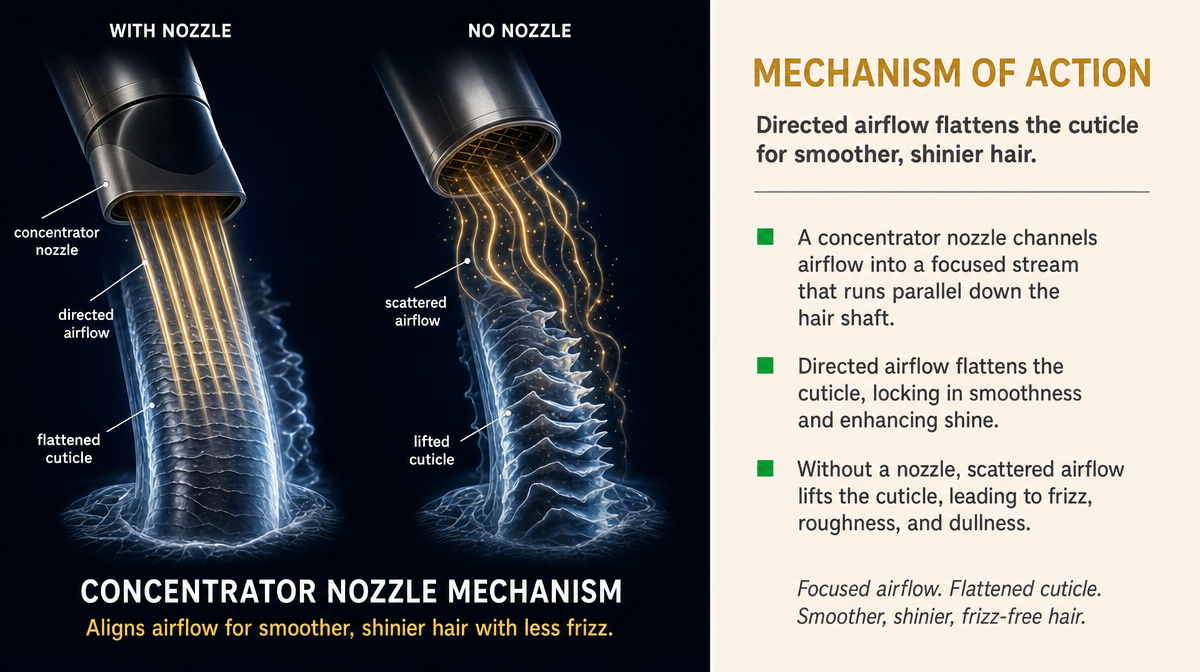
A dryer’s nozzle, the narrow attachment at the end of the barrel, concentrates airflow into a directed stream instead of a wide, unfocused blast. This matters because the cuticle, the outer layer of the hair shaft, lies flat when air is directed downward along its length and lifts when air hits it at random angles.
A lifted cuticle catches light unevenly and feels rough, which is the physical basis of frizz that has nothing to do with product buildup or humidity. Stylists check nozzle fit before anything else, because a nozzle that does not seat snugly on the barrel lets air escape around the edges instead of concentrating it.
In the store, this is easy to check without ever turning the dryer on. Attach the nozzle and look for gaps at the seam. A nozzle that wobbles or sits loosely will underperform even a strong motor, because the directed airflow that actually smooths the cuticle never fully forms.
Some dryers ship with a diffuser instead of, or alongside, a concentrator nozzle. A diffuser spreads air rather than directing it, which suits curl patterns that benefit from gentler, more even drying rather than a smoothing stream. Neither attachment is universally better. The right one depends on the hair pattern being dried.
Testing Weight And Balance Before You Leave The Store
A dryer that feels fine sitting on a store shelf can feel very different after five minutes held overhead at an angle, arm extended, wrist turning. Weight distribution matters more than total weight, because a motor placed too far forward in the barrel makes the whole tool feel front-heavy the longer you hold it.
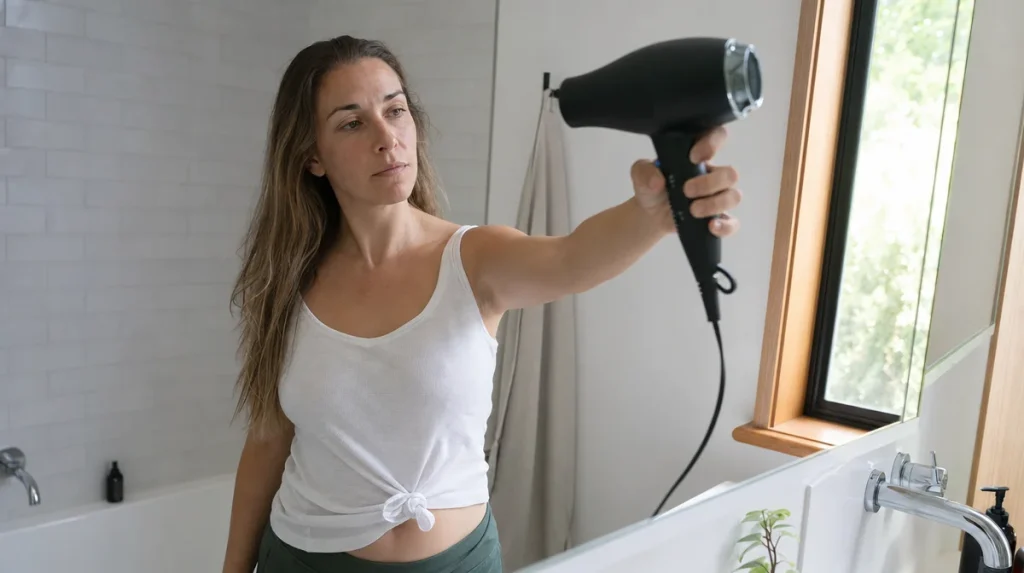
Before buying, hold the dryer the way you actually would at the mirror: arm raised, elbow bent, wrist rotated slightly to angle the nozzle downward. Hold that position for a full thirty seconds. If your wrist starts to ache before the timer runs out, that fatigue will only compound over a full blowout that can run ten to fifteen minutes for shoulder-length hair.
Cord placement affects this too. A cord that exits from the bottom of the handle tends to pull the whole tool downward as you move your arm, adding perceived weight that is not reflected in the spec sheet at all. A cord that swivels at the point where it meets the handle removes most of that drag.
This is a case where showroom handling tells you something a spec sheet cannot. Two dryers can list identical weights in ounces and feel entirely different once your arm is doing the work a scale never does.
Heat Settings And The Mistake Of Always Choosing High
The instinct to reach for the highest heat setting comes from wanting to finish faster, but heat and speed are not the same control, and treating them as one leads to the most common styling mistake stylists report seeing.
High heat evaporates surface water quickly, but it also raises the hair shaft’s internal temperature, which can weaken the protein bonds that keep the cuticle smooth over repeated use. Airflow speed, by contrast, moves water off the hair mechanically, without needing as much heat to do it.
The better combination for most hair, according to guidance the American Academy of Dermatology publishes on heat styling and hair damage, is high airflow speed paired with medium heat, reserving high heat only for the final pass that sets the style. This combination dries hair nearly as fast as high heat alone, with less cumulative thermal stress on strands that get blow-dried several times a week.
A simple in-store check: does the dryer offer at least two heat settings independent of two speed settings, giving four real combinations rather than a single dial that raises both at once? Dryers that couple heat and speed together remove your ability to make this distinction at home, regardless of how strong the ionic claim on the box reads.
What Real Results Look Like At Home, And How Long To Wait
Frizz reduction from ionic airflow is most visible in the first few minutes of drying, while hair is still mostly wet, not at the very end when hair is nearly dry regardless of the tool used. Judging a dryer’s performance by the final result alone misses where the actual difference happens.
A fair home test: dry one section of hair, roughly a two-inch panel near the front, and note how smooth it looks and feels at the three-minute mark, before moving to the rest of the head. That early read tells you more about the dryer’s ion output and airflow strength than the finished style will, because by the time hair is fully dry, technique, product, and simple evaporation have caught up regardless of what dried it.
Results also depend heavily on starting condition. Hair that has been recently colored, chemically treated, or exposed to a dry winter with constant indoor heating will show less dramatic smoothing than healthy, unprocessed hair, simply because the cuticle itself is already rougher at a structural level. This is not a failure of the tool. It is a limit of what airflow alone can do to a cuticle that heat or chemical processing has already lifted.
Give any new dryer two or three full uses before judging it. A single blowout is affected by humidity, product choice, and how recently hair was washed, all of which can mask or exaggerate a dryer’s actual performance.
Marketing Words That Sound Scientific But Aren’t
Ceramic, tourmaline, and far-infrared are three terms that show up on nearly every dryer box at Target or CVS, often stacked together as though each adds a separate benefit. In practice, they describe overlapping things.
Ceramic refers to a coating inside the barrel that distributes heat more evenly than bare metal, reducing hot spots that can scorch a section of hair while leaving another section still wet. Tourmaline is a mineral sometimes ground into that ceramic coating specifically because it generates negative ions when heated, meaning tourmaline is often the actual source of a dryer’s ionic claim rather than a separate feature. Far-infrared describes a type of heat that penetrates the hair shaft more gently than direct convective heat, drying from the inside out rather than baking the surface.
None of these terms are meaningless, but none of them substitute for the airflow strength and nozzle fit discussed earlier. A dryer with tourmaline-ceramic construction and a weak motor still dries hair slowly, and slow drying gives water more time to evaporate unevenly, which is the opposite of what any of these coatings are meant to prevent.
The practical takeaway: treat these terms as supporting features, not headline ones. A publication like Byrdie or Allure testing dryers side by side will note them, but rarely as the deciding factor over motor type and nozzle design.
Cord, Filter, And The Maintenance Nobody Mentions
A dryer’s air intake, the mesh vent at the back of the barrel, pulls in room air that gets heated and pushed forward. Lint, hair, and dust collect on that mesh over weeks of normal use, and a partially blocked intake forces the motor to work harder to pull the same amount of air through.
This shows up as a dryer that seems to lose power over its lifespan, when the motor itself has not changed at all. Most dryers have a removable back cap over the intake specifically so this filter can be cleaned, though the feature goes unused by most owners simply because nobody points it out at the point of sale.
A cord rated for at least eight feet gives enough slack to move around a bathroom counter without stretching, which matters more in older homes where the nearest outlet sits farther from the mirror than expected. A swivel cord, one that rotates freely where it meets the handle, prevents the kind of twisting that eventually frays the cord’s internal wiring at that stress point.
Cleaning the intake filter monthly, more often during a humid East Coast summer when airborne dust and product residue build up faster, keeps a dryer performing closer to its original airflow speed for years rather than months.
Key Takeaways
A dryer’s ionic claim only matters if the airflow behind it is strong enough to carry those ions to the hair shaft, so motor type and nozzle fit come first, the ionic label second. Wattage on the box is a weak substitute for airflow speed, and weight in the hand often tells you more about motor type than the spec sheet does. Frizz reduction shows up earliest in the drying process, not at the finished style, and heat should be treated as a separate control from speed rather than a single dial that raises both together.
A Two-minute Checklist For The Aisle
- Pick up the dryer and hold it at drying angle for thirty seconds to judge fatigue, not just weight in ounces.
- Attach the nozzle and check for gaps at the seam where air can escape unfocused.
- Look for at least two heat settings and two speed settings that can be combined independently.
- Note whether the cord swivels at the handle rather than pulling straight down.
- Remember that ceramic, tourmaline, and far-infrared are supporting features, not substitutes for motor strength.
- Plan to judge results after two or three full uses, not one, since humidity and hair condition affect the first try.
This guide offers general information and does not replace advice from a stylist or dermatologist.
Individual results vary depending on hair type, texture, porosity, and styling habits.