
David Okafor, Senior Health and Science Editor.
You spray the tester at the counter, wait ten seconds, and it smells sharp, almost soapy. Twenty minutes later, walking back to the car, it has turned warmer and sweeter, barely recognizable from the vial. At home, the same bottle fades by early evening, though the box on the shelf promises eight hours of wear. None of that is a flaw in the bottle. It is chemistry doing exactly what chemistry does, and once you know what to look for, you can predict it instead of being surprised by it.
Most buying guides talk about notes and sillage as if they were style preferences. They are really about concentration percentages, molecular weight, and your own skin. A fragrance specialist judging a new eau de parfum is not sniffing for what smells nice. She is reading a formula the way a chef reads a recipe: what evaporates first, what holds the base together, and what will actually survive contact with warm skin for hours rather than minutes on a paper strip.
This guide walks through what that judgment actually involves, in plain language, so the next bottle you pick up stops being a gamble.
- The label percentage tells you concentration, not quality: eau de parfum typically holds 15 to 20 percent aromatic compounds, but two bottles at the same percentage can behave very differently depending on what those compounds are.
- A fragrance is not one smell, it is three acts: top, heart, and base notes evaporate at different speeds, so the scent you smell at minute one is not the scent you will wear at hour four.
- Your skin is part of the formula: pH, oil production, and even diet change how a fragrance reads on you, which is why testing on paper alone is close to useless.
Reading The Concentration Label Without Getting Fooled

The words on the front of the box, parfum, eau de parfum, eau de toilette, eau de cologne, describe roughly how much aromatic compound is dissolved in the alcohol and water base. Parfum, sometimes labeled extrait, generally runs 20 to 30 percent. Eau de parfum sits around 15 to 20 percent. Eau de toilette drops to 5 to 15 percent, and eau de cologne lower still.
Think of it like coffee concentrate. A stronger brew needs less liquid to fill the same cup, and it holds its flavor longer before it goes watery. A higher concentration of aromatic oils works the same way: less alcohol to carry it away, so the scent clings to skin longer and needs fewer reapplications.
The catch is that these percentages are not strictly regulated the way, say, drug dosages are. Brands report them loosely, and a well-built eau de toilette with strong base notes can outlast a poorly constructed eau de parfum. Treat the label as a starting point, not a guarantee. The American Academy of Dermatology’s general guidance on fragrance sensitivity also notes that concentration affects irritation risk, which is one more reason not to buy on label alone.
A quick self-test: spray a small amount on the inside of your elbow, not just your wrist, and check back at the one hour and four hour marks. If it has vanished by hour one regardless of what the box says, the formula, not the label, is telling you the truth.
How A Fragrance Unfolds Over The Day: The Note Pyramid
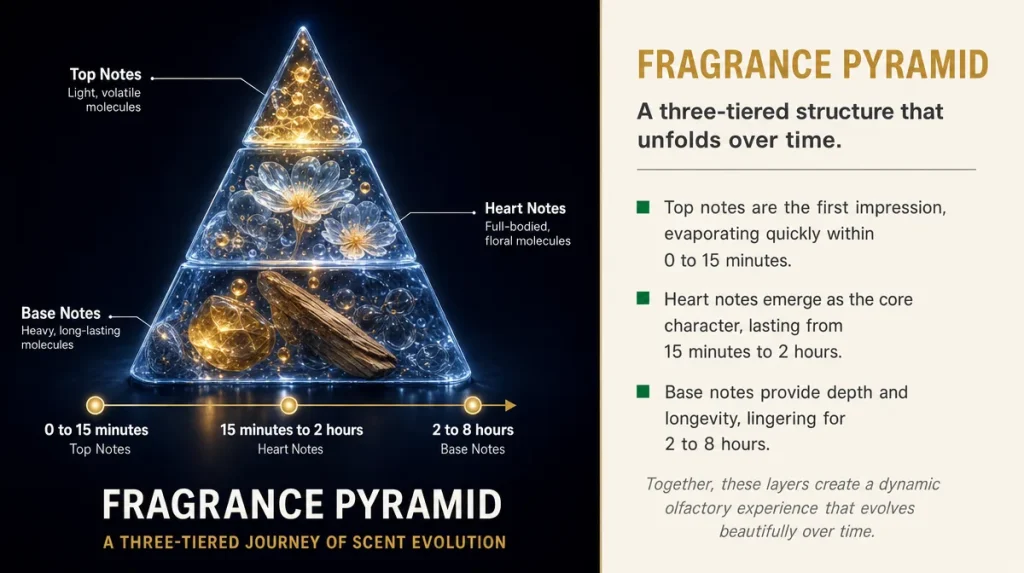
A well-built fragrance is not a single smell, it is a sequence. Perfumers describe it as a pyramid: top notes, heart notes, and base notes, each evaporating at a different rate.
Top notes are usually citrus, light florals, or green accords. They are small, volatile molecules, and they are the first thing you smell and the first thing to disappear, often within 15 minutes. Heart notes, frequently florals or spices, take over next and can last one to two hours. Base notes, things like musk, amber, vanilla, and woods, are heavier molecules that take the longest to evaporate and can still be present after eight hours.
The household version of this is a tray of ice: small chips melt in minutes, while a large block sitting in the same room takes hours. A fragrance is built the same way, with the perfumer deciding how much of each size to include and how they should hand off to one another.
This is why judging a fragrance off a single spritz is misleading. The sharp, sometimes alcohol-forward smell in the first minute is not what you will be wearing at 3 p.m. A specialist waits through all three phases before forming an opinion, and so should you.
Why The Same Bottle Smells Different On You Than On The Tester Strip
Two people can spray the same bottle and describe two different scents, and both are right. Skin is not a neutral surface. Its pH, oil production, hydration level, and even the medications or diet of the wearer change how fragrance molecules bind and volatilize.
A 2016 study published in the journal Chemical Senses found that individual differences in skin surface chemistry measurably altered how the same fragrance compound was perceived by observers over several hours. Oily skin tends to hold fragrance longer because oils slow evaporation. Very dry skin lets a scent fade faster because there is less to grip onto.
The analogy that tends to land: the same seed planted in different soil grows into a different-looking plant. The seed, in this case the formula, is constant. The soil, your skin, is not.
This is also why testing on a paper strip only gets you halfway there. Paper has no oil, no warmth, and no chemistry of its own, so it shows you the formula in a vacuum. It is a useful first filter to avoid wasting time on scents you dislike outright, but the real verdict only comes from skin contact.
A short self-test: apply the fragrance to your wrist in the morning and check it again after lunch, ideally after a period of normal activity rather than sitting still. Body heat and movement change projection in ways a still test cannot show you.
The Right Way To Test A Scent Before You Commit
Most people test fragrance the way they browse a menu, sniffing quickly and moving on. That method almost guarantees a wrong impression, because you are only ever smelling the top notes.
The better method: spray one fragrance on skin, ideally the inner forearm, and walk away from the counter for at least 15 to 20 minutes before forming any judgment. Do not test more than two or three fragrances in one visit. Your nose fatigues quickly, a phenomenon called olfactory adaptation, and by the fourth scent you are no longer smelling clearly.
If you need to reset your nose between tests, smelling your own sleeve or a cup of coffee beans, a common trick used at fragrance counters, can help clear the palate, though the effect is modest and mostly psychological rather than chemical.
The biggest mistake shoppers make is buying on the first ten seconds, when the alcohol carrier is still evaporating and the scent can smell sharper or more medicinal than it will an hour later. Patience at the counter is the single cheapest way to avoid a bottle that sits unused in a drawer.
A useful self-test before any purchase: ask yourself whether you would still want to smell this on a coat or scarf at the end of the day, not just in the first five minutes.
What Actually Determines How Long It Lasts And How Far It Travels
Longevity and sillage get used interchangeably, but they are separate measurements. Longevity is how long you personally can still detect the fragrance on your own skin. Sillage, from the French word for wake, is how far the scent projects outward so others can smell it without leaning in.
A fragrance can have strong sillage and modest longevity, or the reverse. Heavier base notes generally support longevity. Sillage depends more on the volume and type of top and heart notes, plus how much product is applied and where.
Climate plays a real role too. In humid conditions, common on the East Coast through the summer months, fragrance molecules evaporate more slowly and tend to sit closer to the skin, which can mute projection. In dry winter air, especially indoors with heating running, evaporation speeds up, which can make a scent feel like it fades faster even though the same amount was applied.
Dry skin generally holds fragrance less well than skin with a healthy amount of natural oil, since oil slows the rate of evaporation. Applying a fragrance-free moisturizer to pulse points before spraying can extend wear time, a trick worth testing on your own skin rather than assuming it works universally.
The Habits That Quietly Ruin A Good Bottle
Rubbing your wrists together after spraying is close to universal habit, and it is also counterproductive. The friction generates heat and breaks down the more delicate top note molecules faster than they are meant to evaporate, which can distort the opening phase of the scent. Letting the spray settle on its own gives a truer read of what the perfumer intended.
Storage matters more than most people realize. A fragrance kept on a bathroom shelf is exposed to heat, humidity, and light every time someone showers, and all three degrade the compounds over time, sometimes within months. A cool, dark drawer or cabinet away from a window preserves a bottle far longer than a sunny vanity does.
Another common error is spraying only on clothing to avoid staining. Fabric holds scent differently than skin, often flattening the note progression, and it does nothing to solve the actual question of how a fragrance reads on you. If staining is a concern, a light spray on hair, which holds fragrance well and rarely stains, is a reasonable compromise.
Finally, layering too many products, scented lotion, scented hair mist, and perfume all at once, can muddy a carefully built formula into something unrecognizable. If you want to layer, choose an unscented moisturizer as the base and let the fragrance itself do the work.
What’s Chemistry And What’s Marketing Shine
Terms like clean fragrance, natural, and hypoallergenic circulate heavily in fragrance marketing, and they are not standardized terms with a single legal meaning in the United States. A synthetic musk is not automatically worse for skin than a natural extract, and in some cases synthetics are used specifically because they are more consistent and less likely to trigger reactions than certain natural essential oils.
What is regulated, at least on an industry self-governance level, is allergen disclosure through standards set by the International Fragrance Association, which many manufacturers follow globally regardless of where a product is sold. The American Academy of Dermatology’s general public guidance notes that fragrance remains among the most common causes of contact dermatitis, and it advises patch-testing any new fragrance on a small area of skin, such as the inner arm, and waiting 24 to 48 hours before full use.
The more useful question than natural versus synthetic is transparency: does the brand disclose its ingredient list in a way you can actually read, and does the formula hold up on your own skin across a full day, not just the first spray. Marketing language sells a feeling. Your skin, worn for eight hours, tells you the truth.
When comparing two bottles, it helps to judge them the way a lab evaluation might, checking scent trueness against the original impression, lasting power across a full wearing, and how the fragrance behaves once it reaches its base notes, rather than trusting a single word on the box.
Key Takeaways
A fragrance is a formula unfolding in three phases, not a single smell, and it needs at least 20 minutes on real skin, not paper, before you can judge it fairly. Concentration percentages on the label are a rough guide, not a guarantee, since formula construction matters as much as the number. Your own skin chemistry, the climate, and even how you store the bottle change how long and how far a scent travels, often more than the marketing on the box does.
A Quick Checklist For Your Next Counter Visit
- Test no more than two or three fragrances per visit to avoid nose fatigue
- Apply to skin, not just a paper strip, and wait at least 15 to 20 minutes before judging
- Check back at the one hour and four hour marks to see how the base notes settle
- Patch-test on your inner arm and wait 24 to 48 hours if you have sensitive skin
- Store the bottle in a cool, dark drawer, never on a sunny windowsill or steamy bathroom shelf
- Judge ingredient transparency over buzzwords like clean or natural on the label
This article is for general information only and does not replace advice from a dermatologist or allergist.
Individual results and reactions to fragrance ingredients vary by skin type and sensitivity.