
Rachel Tomlinson, Beauty Editor.
You are standing at the bathroom mirror at 7:40 in the morning, blotting a T-zone that has already gone shiny even though you just finished your foundation. Somewhere in the cabinet behind you is a graveyard of half-empty mist bottles: one that smelled nice but did nothing, one that pilled up under your eyes at a wedding, one your friend swore was her holy grail that made your skin feel like plastic wrap by noon. You type the same question into your phone every few months: does setting spray even matter, or is it just water in a fancier bottle?
Here is the useful fact to start with: most setting sprays are mostly water and a small amount of film-forming polymer, and that polymer is doing almost all the work. Once you know what to look for in that short list of active ingredients, and what your own skin actually does over the course of a day, you can judge any bottle on the shelf without needing a single brand recommendation. That is what this guide teaches.
- The polymer, not the perfume, determines performance: look at how a spray behaves on your hand before you judge it on your face.
- Oily and dry skin need opposite chemistry: a mattifying formula and a dewy one are solving different problems, not competing for the same one.
- Application technique changes outcomes as much as formula does: distance, timing, and layering order matter more than most labels admit.
What A Setting Spray Is Actually Made Of
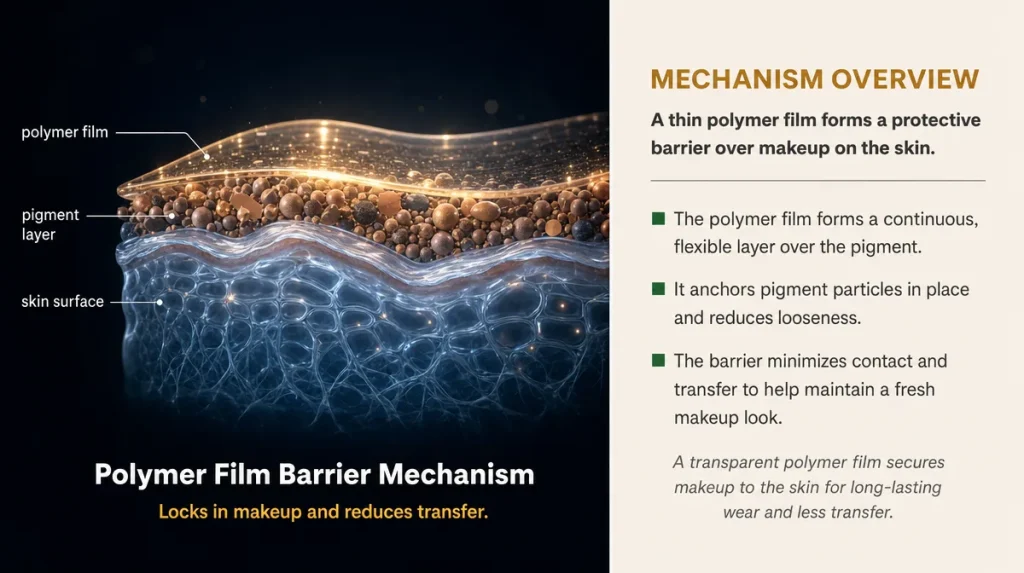
Strip away the marketing copy and a setting spray is a short, unglamorous ingredient list: water, a humectant like glycerin, and one or two film-forming polymers such as acrylates copolymer or PVP. Think of the polymer the way you would think of the varnish on a wood floor. The wood underneath is your makeup. The varnish does not change the wood, it just lays a thin, even layer over it so foot traffic does not scuff it up. A cheap varnish job leaves gaps, so shoes drag the finish anyway. A better one is more evenly distributed.
That is essentially the difference between a setting spray that fades your foundation by lunch and one that holds until dinner. Fragrance, botanical extracts, and “infused” ingredients are mostly there for sensory appeal and packaging copy. A 2021 study in the International Journal of Cosmetic Science testing film-forming polymers on skin substrates found that formulation type affected transfer resistance far more than the presence of secondary conditioning agents. In plain terms: the polymer is the product. Everything else is scent and story.
Matching Formula To Your Actual Skin Type
Oily skin and dry skin are not on the same spectrum with a setting spray in the middle. They need different chemistry entirely.
For oily or combination skin, look for formulas built around silica or matte-finish polymers, sometimes labeled “oil control” or “mattifying.” These work by absorbing surface sebum and creating a slightly stiffer film that resists the warmth of your face. For dry or normal skin, humectant-forward formulas with glycerin or hyaluronic acid sit better, since they add a thin layer of moisture back to the film instead of tightening it.
The mistake almost everyone makes is buying whichever setting spray is trending, without checking which category it belongs to. A mattifying spray on already-dry skin can emphasize flaking within a few hours, because the stiffer film has nothing to flex over. A dewy, glycerin-heavy spray on very oily skin can slip and slide by early afternoon, since it never fully sets. Read the front label copy for words like “matte,” “dewy,” “hydrating,” or “oil-free,” and take those descriptors literally rather than as vague marketing filler. They usually map to a real formulation choice underneath.
The Hand-test: Judging A Spray Before It Touches Your Face
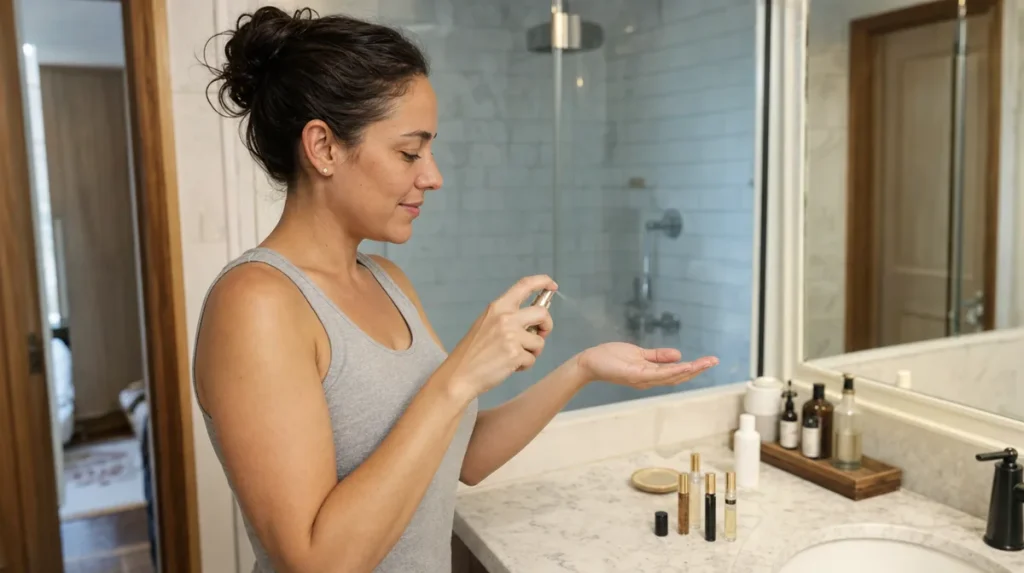
You do not need to buy a bottle to learn how it behaves. Most drugstore and Sephora testers let you spray a small amount on the back of your hand, and this five-minute test tells you more than any review.
Mist a light layer on clean skin. Watch the first ten seconds: does it sit as visible droplets, or does it disappear into an even sheen? Droplets that pool suggest a lower alcohol content and a slower dry time, useful in dry winter air but frustrating if you are in a humid August commute. Wait two minutes, then press a fingertip gently into the mist. If it feels tacky rather than dry, the film has not finished forming and needs more time before you touch your face.
Finally, rub two fingers together over the misted patch. A good film-forming spray will feel slightly smooth, almost like a very thin coat of dried nail polish. If it feels sticky or waxy, that is often a sign of a heavier polymer load, which can look better in the store and feel worse by hour six. This one-minute self-test, done at a counter or over your own bathroom sink, replaces most of what a five-star review claims to know.
Where Inexpensive Sprays Actually Cut Corners
Cheaper setting sprays are not inherently bad, but they do cut corners in specific, checkable ways. The most common shortcut is using a single, older-generation polymer instead of a blended system. Blends are more expensive to formulate but tend to flex better with facial movement, since a smile, a squint, and a raised eyebrow all pull the skin’s surface differently through the day.
Another shortcut is propellant-heavy aerosol delivery instead of a fine-mist pump. Aerosol cans are cheaper to fill but often deliver larger droplets, which can sit on the skin rather than distributing evenly, leading to a patchy, sometimes damp finish that takes longer to set.
A third shortcut is skipping a true two-phase or triple-phase formulation, which requires more manufacturing precision, in favor of a straightforward single-phase mix. Single-phase sprays are simpler and often perform fine for shorter wear, six hours or less, but tend to show their limits by hour eight or nine, particularly in humid conditions. None of this makes a lower-priced spray unusable. It just means the wear time claims on the label deserve a skeptical read, especially if the product does not specify a testing method.
What Realistic Wear Time Actually Looks Like
Marketing copy loves the phrase “all-day wear,” but dermatologic research on cosmetic film stability suggests most setting sprays realistically extend makeup wear by three to six hours beyond an unset base, not sixteen. A 2019 wear-time study published in the Journal of Cosmetic Science, which tracked foundation transfer on facial skin over eight hours, found that setting products reduced smudging and transfer by up to 40 percent compared to unset makeup, but did not eliminate it.
In practice, that means a spray applied at 7 a.m. is doing meaningfully less work by 3 p.m., especially around the nose, chin, and hairline, where oil production is highest. Humid East Coast summers accelerate this timeline further, while dry winter air with indoor heating can actually extend it, since there is less ambient moisture to break down the film.
A fair way to judge a spray’s real performance is to check your reflection at the three-hour and six-hour marks on a normal day, not a special-occasion one. If foundation has visibly shifted or oxidized by hour three, the formula is underperforming for your skin type regardless of what the label promises.
Application Distance And Timing, Not Just Formula
Even a well-formulated spray fails if it is applied wrong, and this is the most overlooked variable in the entire routine. Holding the bottle six to eight inches from your face, roughly an arm’s length bent at the elbow, produces the finest, most even mist. Spraying closer concentrates droplets in one area and can disturb blended concealer or bronzer underneath.
Timing matters just as much. Applying immediately after finishing makeup, before any product has had a chance to settle into the skin, can cause pigments to shift or streak, particularly with cream products. Waiting sixty to ninety seconds after your last step, letting the base warm slightly to skin temperature, gives the setting spray a more stable surface to lock down.
A common mistake is treating setting spray like a finishing touch you can rush on the way out the door. Two light passes, in a loose X or T shape across the face, outperform one heavy pass every time, since a single saturated spray oversaturates certain areas while leaving others under-treated. Let each pass dry for a few seconds before the next.
Reading Labels Without Falling For The Marketing
Certain words on a setting spray label are functional, and others are decorative. “Long-wear,” “waterproof,” and “transfer-resistant” typically refer to specific, testable polymer behavior, and brands that back these claims often note an internal wear-time test, though methods vary and are rarely standardized across the industry.
“Infused with rosewater” or “botanical mist” mostly describes scent and sensory experience layered on top of the functional formula, not a meaningful change in hold. This is not dishonest, but it is decoration, not substance.
The American Academy of Dermatology’s general consumer guidance on cosmetic ingredient labeling recommends checking the first five ingredients on any product, since concentration generally decreases down the list. Applied here, if water is followed immediately by a named polymer, the product is likely built for genuine hold. If water is followed by several plant extracts before any film-former appears, the spray may lean more toward a refreshing mist than a true setting product. Reading in this order takes under a minute at a Target or Ulta Beauty aisle, and it is more reliable than any five-star average.
Judging Your Own Results, Week By Week
A single day of wear tells you something, but a fair judgment needs about two weeks of ordinary use, not one dramatic event. Track three things: how your skin looks at the three-hour mark, whether the spray causes any pilling when layered over sunscreen or moisturizer, and whether your skin feels different by evening, tighter, oilier, or unchanged.
Pilling, where product balls up into small visible flecks, usually signals incompatible textures rather than a bad spray on its own. It often means a heavier cream or SPF underneath has not fully absorbed before the mist was applied. Waiting a full two minutes after sunscreen, particularly a physical, mineral-based one, tends to reduce this.
Seasonal shifts matter too. A formula that performs beautifully in October, dry, cooling weather, pumpkin-spice season by any other name, may behave differently in July humidity. Reassess rather than assuming a spring purchase will perform the same way through a humid summer.
Key Takeaways
A setting spray’s real performance comes down to a short polymer list, not the fragrance or the story on the front of the bottle. Match the formula category, matte or dewy, to your actual skin type rather than to what is trending. Test on the back of your hand before committing to a full face. Apply at the right distance, in light passes, and give it a minute to actually form a film. Judge results over three-hour and six-hour checkpoints across at least two weeks, and expect performance to shift somewhat with the seasons.
A Quick Checklist Before You Buy
- Check the first five ingredients: water followed by a named polymer suggests genuine hold.
- Match “matte” formulas to oily or combination skin, and “hydrating” or “dewy” formulas to dry or normal skin.
- Do the hand-test: mist, wait two minutes, then check for tackiness or a smooth, dry finish.
- Hold the bottle six to eight inches away and apply in two light passes, not one heavy one.
- Wait sixty to ninety seconds after finishing makeup, and after sunscreen, before misting.
- Reassess performance at the three-hour and six-hour marks, on an ordinary day.
- Expect wear time to shift with humidity and indoor heating across seasons.
This article is for general information only and does not replace individualized advice from a dermatologist or other qualified professional.
Individual results vary based on skin type, climate, and application method.