
Rachel Tomlinson, Beauty Editor.
There is a specific kind of disappointment that happens around noon. You curled your lashes before work, swept on two coats of your holy grail volumizing mascara, and by lunch they have gone flat against your lid, or worse, smudged into a gray crescent underneath your eye. You start typing questions into your phone at your desk: why does my mascara clump, why do my lashes look thin by the afternoon, is there a wand that actually works. Here is one fact worth knowing before anything else: mascara does not manufacture volume from nothing. It coats and holds whatever shape and thickness your lashes already have. Nearly every common mistake with volumizing formulas comes from asking the product to do a job that belongs to technique, timing, or the brush itself. This guide walks through where that goes wrong and how to fix it, step by step, with nothing to buy at the end.
- Volume comes from air trapped between coats, not from more product piled on, so technique matters more than formula strength.
- Most clumping is a wand and drying-time problem, not a bad-mascara problem, and switching brands rarely fixes it on its own.
- Mascara has a real shelf life of about three months once opened, after which flaking and irritation risk climb even if the tube still looks full.
Why Lashes Go Flat By Noon
Lashes are not solid rods. Under magnification, each one has a slight natural curve and a texture that resembles a very fine hair, because that is exactly what it is. When mascara dries, it forms a thin shell around the hair shaft. That shell is what creates the illusion of thickness.
The problem is gravity and time. As the day goes on, oil from your skin and the natural oil your eyelids produce along the lash line soften that shell. Combined with blinking thousands of times a day, the coating slowly loses its shape and the lash relaxes back toward its resting position, which for most people points down and slightly inward.
Think of it the way you would think of a starched shirt collar. Starch holds a crisp shape for a while, but humidity and movement wear it down over the course of a day. Volumizing mascara works on the same principle: it is a temporary stiffener, not a permanent structural change.
The mistake most people make is reapplying more product midday, hoping to restore the original volume. This usually backfires, because the new layer goes over lashes that already have oil on them, and it tends to clump rather than build. A blotting motion with a tissue at the base of the lashes, followed by a very light single fresh coat, holds up far better than a full second application.
The Wiggle-and-pull Method, Done Right
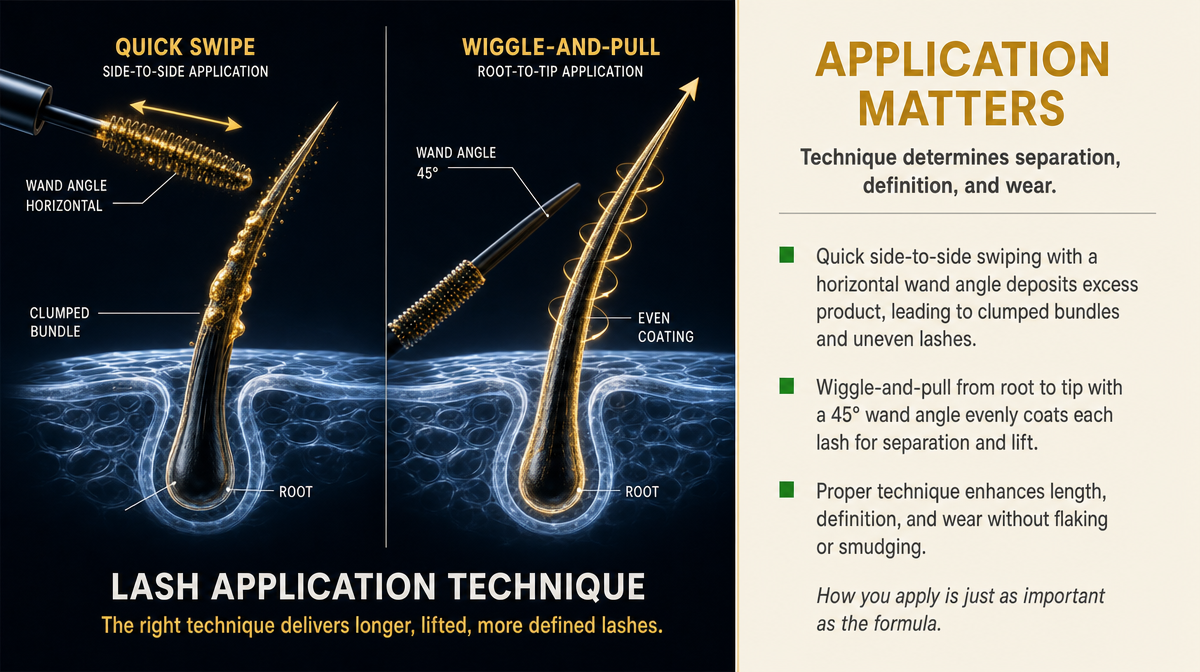
Most volumizing failures trace back to the same motion: a single quick swipe from root to tip. That deposits product unevenly and misses the base of the lash, which is where most of the visible thickness actually comes from.
The method dermatologists and makeup artists both describe in trade interviews is a wiggle at the root followed by a slow upward pull. Place the wand flat against the base of the upper lashes, move it side to side for two or three seconds to distribute product between individual lashes, then draw it upward in one continuous motion to the tips.
The wiggle matters because it works product between lashes that are naturally clumped together from blinking and rubbing. Without it, mascara sits on top of a bundle of two or three lashes instead of coating each one individually, which reads as thinner overall even though the same amount of product went on.
A quick self-test: look at your lashes in a magnifying mirror right after applying. If you see visible gaps with bare patches of skin between defined clumps, the wiggle step was skipped or rushed. Full, separated coverage should show fine coated lashes lying close together with daylight barely visible between them, not solid gray triangles.
Why Clumping Happens, And It Is Rarely The Formula’s Fault
Clumping gets blamed on mascara formulas constantly, but the more common cause is timing and wand pressure.
Every time a wand goes back into the tube, it pushes air in and pulls product out unevenly, which thickens the formula near the opening over weeks of use. That thickened product near the tube’s mouth is what ends up on the wand in uneven globs. Pumping the wand in and out of the tube to “reload” it, a habit many people picked up without thinking, accelerates this by forcing air in faster than it would otherwise enter.
The fix is mechanical, not chemical: twist the wand gently while withdrawing it rather than pumping, and wipe any visible excess against the tube opening before it reaches your lashes.
A second cause is layering wet coats too quickly. Volumizing formulas are often slightly thicker than lengthening ones, and applying a second coat before the first has begun to set traps product in ropey strands rather than a smooth film. Waiting roughly fifteen to twenty seconds between coats, enough time to see the first layer dull slightly as it dries, gives a noticeably smoother second pass.
If clumping persists even after these adjustments, it is worth checking the tube’s age before switching products entirely. Mascara that has passed its useful life, discussed further below, thickens and clumps no matter how careful the technique.
Curling Before Or After: The Sequence That Matters
The order of operations gets debated constantly, and the answer is simpler than the arguments suggest: curl first, mascara second, always.
An eyelash curler works by bending the hair shaft slightly, and that bend holds best while the lash is still dry and untreated. Applying mascara first coats the lash in a film that can make it brittle once clamped, and in some cases the curler pulls away flecks of dried product along with a few lashes. Curling over already-mascaraed lashes is one of the more common causes of lash breakage that people mistake for normal shedding.
Once curled, give it a beat before applying product. Lashes need a few seconds to relax into the new curve; mascara applied the instant the curler releases can flatten that curve right back out.
A heated lash curler, if you use one, needs even more caution: heat plus wet mascara is a combination that can singe or overly stiffen the hair shaft, according to guidance dermatologists commonly give about heat styling near the eye area. Curl, wait, then apply.
If your lashes tend to drop their curl within an hour regardless of sequence, the more likely cause is naturally straight, downward-pointing lashes rather than technique. In that case, a lash primer applied before mascara, which adds a base coat of fiber-building formula, tends to extend hold longer than any amount of extra mascara would.
How Many Coats Is Too Many
Two coats is the practical ceiling for most people, and even that second coat should be thin.
Each additional coat adds weight before it adds visible volume, and lash hair, like any hair, has a limit to how much wet product it can hold before it starts to sag under its own weight. Past that point, extra coats do not build thickness so much as they build droop, which looks the opposite of voluminous by midafternoon.
The visual cue to watch for is a slight downward curve appearing at the very tips of your lashes right after you finish applying, before you have even left the mirror. That is the formula telling you it has reached its limit for that pair of lashes. A third coat on top of that will only make the sag worse once oil and humidity soften the layers later in the day.
A 2019 study in the International Journal of Cosmetic Science measuring lash curl retention over an eight-hour period found that lashes with two coats of a volumizing formula held significantly more curl than those with three or more, largely because of this added-weight effect. If you feel you need more definition after two coats, focus the extra product on the outer corner lashes only, where a slight upward flick of extra volume tends to read as more dramatic without weighing down the whole lash line.
Reading The Wand Instead Of The Marketing Copy
Packaging language like “instant volume” or “fiber technology” describes a formula’s intention, not its physical shape, and the wand shape is what actually determines how the product sits on your lashes.
A thick, densely bristled brush deposits more product per stroke, which suits lashes that are naturally sparse but can overwhelm lashes that are already full, tipping quickly into clump territory. A thinner, more tapered wand lays down a lighter, more controlled coat and tends to reach the small inner-corner lashes that thicker wands skip entirely.
Rubber or silicone bristles, as opposed to nylon fiber brushes, generally comb through lashes more than they coat them, which separates well but builds volume more slowly. Neither is objectively better; the choice depends on your starting lash density and how much separation versus thickness you are after.
A useful in-store or at-home check, if you still have the tube’s original packaging: look at the wand shape before reading a single word on the box. Hourglass shapes are built to control the tricky inner corners. Larger ball or cone-shaped brushes are built to grab more lashes per stroke for overall bulk. Curved wands follow the natural arc of the eye and tend to help with lifting the outer lash line specifically. Matching wand shape to your actual lash pattern does more for results than any ingredient list on the box.
When Flaking Means It Is Time To Replace, Not Reapply
Flaking partway through the day gets treated as a formula problem, but it is frequently an expiration problem.
Mascara is a wet product applied close to a mucous membrane, and it is reopened and exposed to air, warmth, and bacteria from your lashes every single time you use it. The American Academy of Dermatology has noted in public guidance on eye cosmetics that mascara should generally be replaced roughly every three months, both because the formula dries out and thickens, and because bacterial growth inside the tube climbs steadily after the first few weeks of use.
A tube that flakes constantly, smells slightly different than it did when new, or has visibly dried and stringy product near the opening has almost certainly passed that window, regardless of how much product remains inside.
A simple household comparison: think of it the way you would think of a carton of milk. The date on the outside is a general guide, but a change in smell or texture tells you faster and more reliably than any printed date. The same logic applies here. If the wand starts dragging rather than gliding, or the formula clumps immediately even with fresh technique, that is the tube signaling it is done, not a sign you bought the wrong mascara.
Writing the date you opened a new tube on a small piece of tape on the bottom is a low-effort habit that solves this guessing game entirely.
What Actually Causes Irritation, And What Does Not
Red, itchy eyes after wearing mascara get blamed on “sensitive formulas,” but the more common culprits are mechanical, not chemical.
Sharing mascara, even with a close friend or sister, is one of the more reliable ways to introduce bacteria that a person’s own eyes have no built-in tolerance for. So is failing to remove mascara fully before bed, which leaves a dried film sitting against the lash line and eyelid margin overnight, a practice a small clinical survey referenced by the Mayo Clinic’s general eye-care guidance associates with increased complaints of lid irritation and, less commonly, styes.
Removal matters as much as application. A gentle, oil-based remover breaks down the waterproof or long-wear polymers that give volumizing formulas their staying power far more effectively than soap and water alone, which often just smears the product rather than lifting it. Tugging or rubbing to remove stubborn mascara is what damages lashes over time, not the mascara sitting on them during the day.
A reasonable self-check: if irritation shows up only on days you wear a specific formula, that points to the product itself and is worth discussing with a dermatologist. If it shows up regardless of brand, but tends to follow late nights or rushed removal, the mechanism is very likely mechanical rather than a true sensitivity, and adjusting the bedtime routine solves more than switching mascaras ever will.
Key Takeaways
Volume is mostly a technique problem before it is a shopping problem. A wiggle at the root, a slow pull to the tip, two thin coats instead of three heavy ones, and curling before rather than after mascara solve most of the flatness and clumping people chase new tubes trying to fix. The wand shape matters more than the words on the box, and a tube past roughly three months old will underperform no matter how good the formula once was.
A Quick Checklist Before Your Next Application
- Curl first, wait a few seconds, then apply mascara, never the reverse
- Wiggle the wand at the root for two to three seconds before pulling to the tips
- Limit yourself to two coats, letting the first dry about fifteen seconds before the second
- Twist the wand out of the tube rather than pumping it in and out
- Check the wand shape against your actual lash pattern, not the marketing claim on the box
- Write the open date on the tube and retire it around the three-month mark
- Remove fully every night with an oil-based remover rather than rubbing or soap and water
This article is for general information only and is not a substitute for personalized advice from a dermatologist or eye care professional.
Individual results with any technique or product may vary.